
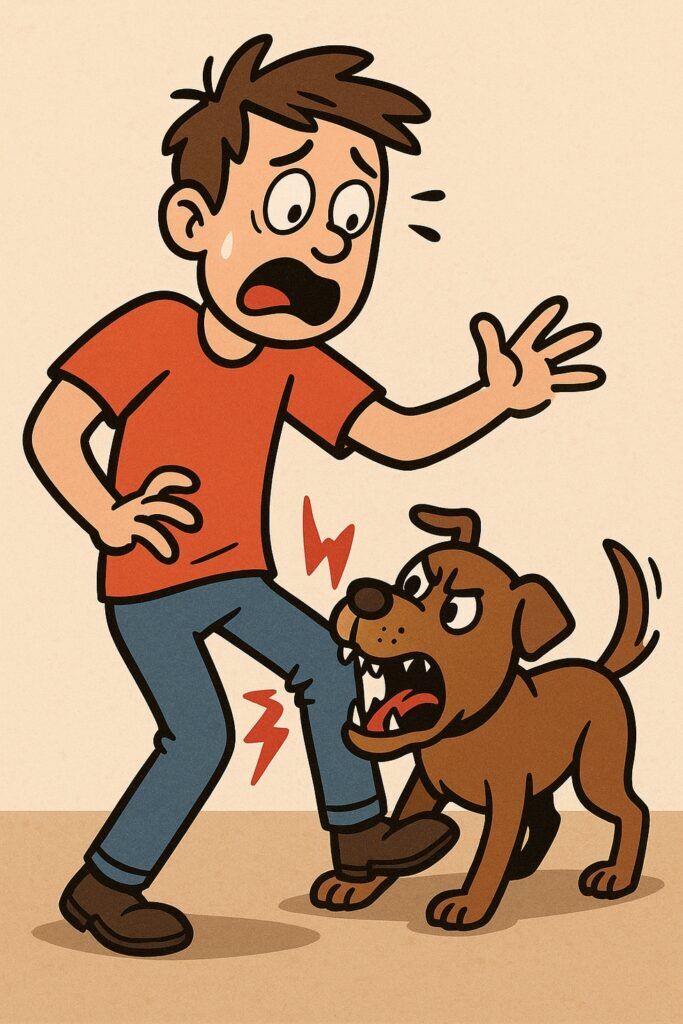
Short answer: Idaho does not give a dog one consequence-free bite. Under Idaho Code § 25-2810(11), an owner—or a person who accepted responsibility for the dog as its possessor, harborer, or custodian—may be civilly liable when the dog attacks or injures a person who was not trespassing and the dog was not physically provoked or otherwise justified. A prior bite, dangerous-dog finding, or court restriction is not required. The facts surrounding trespass, provocation, responsibility for the dog, and causation still matter.
Is Idaho a “one-bite” state?
No. The current civil-liability rule is in Idaho Code § 25-2810(11). It covers a dog that physically attacks, wounds, bites, or otherwise injures a person. The statute expressly says a prior dangerous- or at-risk-dog determination is not a prerequisite to civil liability.
That last sentence is why “one free bite” is a misleading description of present Idaho law. In Boswell v. Steele, 164 Idaho 208, 428 P.3d 218 (2018), the Idaho Supreme Court noted that the Legislature acted to supplant the common-law liability theories discussed in the opinion when it enacted § 25-2810 in 2016. The case involved an earlier incident and analyzed the former common law; the Court’s footnote identifies the statutory change rather than deciding every question under subsection (11).
What must an injured person establish under § 25-2810(11)?
The text identifies four central questions:
- Did the dog cause an injury? The provision reaches an attack, wound, bite, or other injury, so a puncture wound is not the only possible event.
- Was the injured person trespassing? Subsection (11) applies to a person who was not trespassing. The location, permission to be there, and scope of that permission can therefore be important.
- Was the dog physically provoked or otherwise justified? The statute incorporates the circumstances listed in subsection (5).
- Who owned or accepted responsibility for the dog? Potentially covered people include an owner and a person who accepted responsibility as a possessor, harborer, or custodian. A label alone does not resolve that factual question.
The statute removes prior knowledge of viciousness as a prerequisite, but it does not eliminate proof of injury, causation, damages, or the statutory conditions. The Idaho dog-bite claim guide explains how those issues fit into a broader injury claim.
Which provocation and justification issues does Idaho law identify?
Section 25-2810(4)(c) defines “justified provocation” by asking whether a reasonable person with common knowledge of dog behavior would view the act or omission as likely to precipitate an ordinary dog’s bite or attack. Subsection (5) says the category includes, but is not limited to, situations in which:
- the dog was defending a nearby person from an attack or assault;
- the injured person was committing a crime or offense on the owner’s or custodian’s property;
- the person had willfully tormented, abused, or assaulted the dog, either then or in the past;
- the dog was reacting to pain or injury or protecting its offspring;
- the person interfered with a lawfully working hunting, herding, or predator-control dog;
- the dog was a service animal trained to perform work or tasks for a person with a disability; or
- the person intervened between animals engaged in aggressive behavior or fighting.
Those provisions should be applied to evidence, not reduced to slogans. A warning sign, a startled reaction, a child’s age, or an assertion that someone “should have known better” does not automatically decide statutory justification. Witness accounts, video, the physical setting, prior interactions, and the reason the person was present may all affect the analysis.
Are police dogs always exempt?
No. Idaho Code § 25-2808 describes a narrower law-enforcement-dog protection. It applies to the state, a city or county, or an employed peace officer when the dog was trained to assist law enforcement and the injury occurred while the dog was being reasonably and carefully used to apprehend, arrest, or locate a suspected offender or to maintain or control public order.
The production article’s broader reference to police or military dogs being exempt was not supported by that text. A public-entity claim can also involve separate notice requirements, immunities, and deadlines that are outside this article’s one-bite-law focus.
Who may be responsible besides the dog’s titled owner?
Subsection (11) refers not only to the owner but also to a person who accepted responsibility as the possessor, harborer, or custodian. That can make evidence about actual care and control important when, for example, a sitter, household member, or business was handling the dog.
Property ownership alone should not be treated as automatic dog ownership or custody. In Bright v. Maznik, 162 Idaho 311, 396 P.3d 1193 (2017), which arose under the prior law, the Idaho Supreme Court held that owning the rental property and allowing a tenant’s dog there did not by itself make the landlords harborers; the decision predates an appellate interpretation of every part of current subsection (11). The lease, control, knowledge, and conduct still require case-specific analysis.
Does comparative fault automatically reduce every Idaho dog-bite claim?
It should not be assumed from a generic percentage example. In Boswell, the Idaho Supreme Court held that damages on the earlier common-law claim could be reduced proportionately under Idaho Code § 6-801. That case’s bite predated § 25-2810, so it did not decide every verdict issue under current subsection (11). Section 6-801 addresses negligence and comparative responsibility, reduces recoverable damages in proportion to responsibility attributed to the person recovering, and says it creates no new defense. Section 6-803 addresses individual comparisons and proportionate judgments in covered actions.
The statutory dog-injury claim has its own express no-trespass and no-justification conditions. Whether a case also includes negligence, premises-liability, or other claims—and which conduct can properly be placed on a verdict form—depends on the pleaded theories and evidence. The prior article’s example that “ignoring warning signs” necessarily makes a claimant 50% at fault overstated what the cited statutes establish.
Three examples of how the rule may work
These are hypothetical issue-spotters, not predicted outcomes:
A first bite at a front door
A delivery driver lawfully approaches a home and is bitten without physically provoking the dog. The absence of a prior bite or dangerous-dog order does not, by itself, defeat subsection (11). The parties would still need evidence about permission, provocation, identity, injury, causation, and damages.
A person separates fighting dogs
A bystander is injured while reaching between two fighting dogs. Subsection (5) specifically identifies intervention between animals engaged in aggressive behavior or fighting as justified provocation. The exact sequence, the dog involved, and any other viable theory would need careful review.
A dog is with a temporary caretaker
A sitter accepts the dog for the weekend, exercises control, and the dog injures a visitor. Subsection (11) makes responsibility as possessor, harborer, or custodian relevant, so the analysis is not limited to whose name appears on a license or veterinary record.
What damages and deadlines can matter?
A claimant may seek legally recoverable losses that the evidence connects to the incident. Depending on the facts, those can include reasonable medical expenses, documented wage loss, diminished earning capacity, property damage, scarring or disfigurement, and noneconomic harm. The amount is not a standard price per bite or scar. Medical records, photographs, wage records, testimony, and competing causation evidence matter. The separate guide to pain-and-suffering evidence in Idaho explains the proof question without promising a settlement value.
Idaho Code § 6-1603 generally limits noneconomic damages in personal-injury actions and adjusts the amount each July 1, subject to statutory exceptions. The Idaho Industrial Commission’s unofficial calculation lists $538,425.04 for incidents governed by the cap effective July 1, 2026. The incident date and the willful/reckless-misconduct and felony-act exceptions must be checked before applying that figure.
Idaho Code § 5-219 generally gives two years for an action for injury to a person, with accrual language and limited exceptions that require careful reading. Minority does not simply move every deadline to the eighteenth birthday: § 5-230 excludes qualifying disability time but caps tolling on account of minority at six years. The Idaho personal-injury deadline guide covers other common deadline traps.
What should someone do after a dog bite?
Address safety first. Call 911 for uncontrolled bleeding, loss of function, or another apparent emergency. The CDC’s current dog-bite guidance advises washing a wound with soap and water, seeking appropriate medical evaluation, and discussing tetanus and rabies risk with a healthcare or public-health professional. It also recommends reporting a bite to local animal control or police. Do not make your own rabies-treatment decision from a web article.
When it can be done safely and lawfully, preserve photographs, the location, the dog and handler’s identity, witness contacts, reports, clothing, medical records, bills, and missed-work records. Do not provoke, seize, or approach the animal to obtain evidence. The step-by-step article on what to do after an Idaho dog bite keeps that practical task separate from this legal-rule explanation.
When a legal review may help
A focused review can identify the legally responsible person, preserve insurance and notice evidence, analyze trespass or provocation, and calculate the actual filing deadline. Attorneys of Idaho can assess those issues without treating strict liability as a guaranteed outcome. To discuss a specific incident, request a consultation.
Sources and legal references
- Idaho Code §§ 25-2810 and 25-2808, current Idaho Legislature text.
- Idaho Code §§ 5-219 and 5-230, limitation and disability-tolling provisions.
- Idaho Code §§ 6-801, 6-803, and 6-1603, comparative responsibility and noneconomic-damages provisions.
- Boswell v. Steele, 164 Idaho 208, 428 P.3d 218 (2018), Idaho Supreme Court opinion text in a public-domain reporter copy; official reporter and docket citation provided.
- Bright v. Maznik, 162 Idaho 311, 396 P.3d 1193 (2017), Idaho Supreme Court opinion text in a public-domain reporter copy; official reporter and docket citation provided.
- Idaho Supreme Court opinions search, current official archive index checked September 2, 2026.
- Idaho Industrial Commission, “Calculation — Non-economic Damages Caps,” effective July 1, 2026 (unofficial courtesy calculation).
- Centers for Disease Control and Prevention, “Dogs,” current dog-bite safety and reporting guidance.
This article provides general information, not legal or medical advice. Results and deadlines depend on the facts and law applicable to a particular incident. Reading this page does not create an attorney-client relationship.
Legal review
Legal reviewer
Reviewed by J.W. Bond , Founding Attorney and Partner on September 2, 2026.