
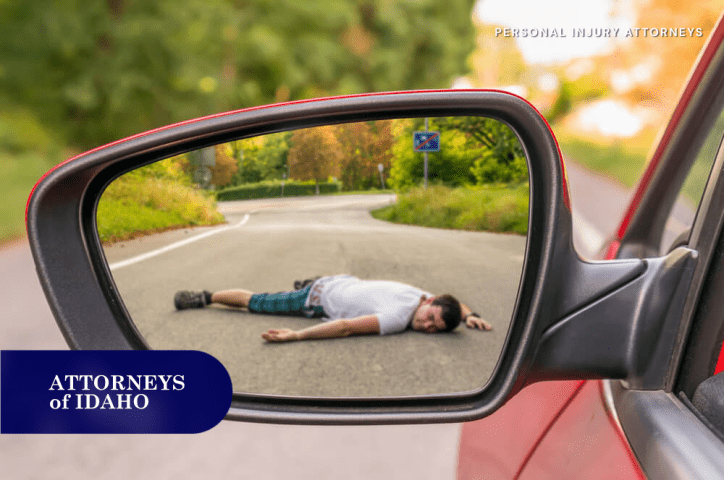
Short answer: After an Idaho hit-and-run, get to a safe place, call 911, request emergency help when needed, and record the vehicle, direction of travel, witnesses, cameras, debris, and damage before evidence disappears. Report the loss promptly to your insurer, but do not assume uninsured-motorist coverage applies. Unknown-driver coverage can turn on the policy’s wording, notice duties, physical contact, and proof. UM, collision, and MedPay address different kinds of loss.
What to Do in the First Hour After an Idaho Hit-and-Run
- Protect people first. Move out of active traffic if that can be done safely. Call 911, report that the other driver left, and request police and emergency medical help when anyone may be injured. Do not chase the fleeing vehicle.
- Record what you remember immediately. Write or dictate any full or partial plate, vehicle color, make, model, body style, visible damage, stickers, direction of travel, driver description, passengers, and unusual sounds. Mark what you actually saw rather than filling gaps with guesses.
- Photograph the full scene. Capture wide views, lane positions, signals and signs, skid or tire marks, debris, vehicle damage, injuries that are visible, and nearby businesses or homes that may have cameras. Preserve the original files; do not rely only on images compressed by text or social media.
- Identify independent evidence. Get each witness’s name and reliable contact information. Ask whether a witness, vehicle, business, residence, bus, or delivery vehicle recorded the event. Video systems may overwrite files quickly, so a prompt, specific preservation request can matter.
- Get the incident details. Record the responding agency, officer’s name, incident or case number, tow company, and storage location. Send law enforcement any later-located video or witness information and keep proof of the submission.
- Notify your insurer promptly. Use the reporting method in the policy and save the claim number and every communication. Ask for the complete policy in effect on the crash date, including declarations, endorsements, and any UM/UIM selection or rejection records.
For a broader scene checklist, see what to do immediately after an Idaho car accident. This page focuses on the extra identification, evidence, and first-party insurance issues created when a driver leaves.
What Idaho Law Requires a Driver to Do
When someone is injured or killed
Idaho Code § 18-8007 applies when a driver involved in an accident on public property, or private property open to the public, knows or has reason to know the accident resulted in injury or death. The driver must stop as close to the scene as possible, remain, provide specified identifying, vehicle, and insurance information, show a driver’s license if available, and provide reasonable assistance to an injured person when the statute’s conditions are met.
Violating any provision of § 18-8007 is a felony punishable by a fine of up to $5,000, imprisonment for up to five years, or both. The statute also directs a one-year license revocation without a work permit or other limited driving privilege.
When an attended vehicle is damaged but no one is injured
For an accident resulting only in damage to a driven or attended vehicle, Idaho Code §§ 49-1301 and 49-1302 require the driver to stop, remain until the legal requirements are fulfilled, and provide a name and address. If available at the scene, the driver must also exhibit a driver’s license, registration, and proof of liability insurance. Failure to stop or comply under § 49-1301 is a misdemeanor, and a conviction under subsection (1) carries a one-year license revocation. A willful failure to provide the required information, or knowingly providing false information, is also a misdemeanor under § 49-1302.
When an unattended vehicle or roadside property is struck
Idaho Code § 49-1303 requires a driver who hits an unattended vehicle to stop and either locate the owner or operator and provide the driver’s and vehicle owner’s names and addresses, or leave a conspicuous written notice with that information and a statement of the circumstances. Section 49-1304 separately requires reasonable steps to locate and notify the person responsible for a damaged fixture or other property legally on or next to a highway, along with the information specified in that section.
When immediate notice to law enforcement is required
Under Idaho Code § 49-1305, a driver must immediately use the quickest means to report an accident involving injury, death, or damage to any one person’s property exceeding $1,500. The notice goes to local police if the crash occurred within a city; otherwise, it goes to the county sheriff or nearest state police office. Even if the apparent damage seems lower, the Idaho Department of Insurance advises calling police after an auto accident, and a prompt report may be required by the insurance policy.
A leaving-the-scene offense addresses conduct after an accident. It does not, by itself, decide who caused the original collision, which losses were legally caused by it, or what an insurer must pay.
Which Coverage May Address Each Loss?
No single “hit-and-run coverage” automatically pays every loss. The accident facts, the identity of the people insured, the policy in force, its endorsements and exclusions, and proof of damages all matter.
| Coverage or claim | Potential role | Important limit |
|---|---|---|
| At-fault driver’s bodily-injury liability | May address covered injury damages if the driver is found, legally responsible, and insured. | The driver must be identified and coverage, fault, causation, damages, defenses, and limits still must be resolved. |
| Your uninsured-motorist bodily-injury coverage | May address covered bodily injury caused by an unknown or uninsured driver when the policy’s definition and conditions are satisfied. | Unknown-driver coverage is not guaranteed; rejection records, insured status, notice, physical contact, corroboration, and other policy language may matter. |
| Your collision coverage | May pay covered repair or replacement costs for your vehicle, usually subject to a deductible. | It must have been purchased before the loss and does not pay bodily-injury damages. |
| Your medical payments coverage | May pay covered medical or funeral expenses for you or passengers, typically regardless of fault. | It is optional, has its own limit and terms, and does not replace a bodily-injury claim. |
Idaho’s statutory UM requirement concerns bodily injury, sickness, disease, or death—not automatic payment for damage to your car. The Department of Insurance explains that a person generally needs collision coverage purchased before the loss for their own insurer to pay covered collision damage. MedPay is another optional and separate coverage. The broader guide to uninsured and underinsured driver claims in Idaho addresses identified uninsured drivers and other coverage questions.
Why the Exact Unknown-Driver Policy Language Matters
UM may have been rejected
Idaho Code § 41-2502 generally requires qualifying Idaho auto policies to include UM and UIM bodily-injury coverage unless a named insured rejects either or both in writing or in an authorized electronic record. A rejection may continue for renewal or replacement policies issued by the same insurer or an affiliate. A declarations page alone may not answer whether the coverage exists, who qualifies as an insured, or which endorsement controls.
An unidentified vehicle is not automatically treated as uninsured
Idaho Code § 41-2503 preserves policy terms and conditions except for the definitions addressed in that statute. In Hammon v. Farmers Insurance Co. of Idaho, the Idaho Supreme Court held that Idaho’s UM statute neither mandates nor prohibits hit-and-run coverage and enforced the physical-contact condition in the policy before it. Stamper v. Allstate Insurance Co. followed Hammon in another no-contact crash and again enforced the policy’s contact requirement.
The Stamper majority did not establish independent corroboration as a substitute for an unsatisfied physical-contact term, even though the record included an asserted eyewitness. Miller v. U.S. Fidelity & Guaranty Insurance Co. likewise treated “hit” or “struck” language as requiring contact. It discussed direct contact and indirect contact through an intermediate object, while distinguishing an evasive response without contact.
Those cases do not mean every current policy is worded the same way. A policy might define an unknown vehicle, physical contact, indirect contact, prompt reporting, independent corroboration, or proof requirements differently. Witnesses, dash-camera footage, vehicle marks, debris, and contemporaneous police and insurer reports remain important even when corroboration cannot replace a separate contact condition. Do not assume that a no-contact “phantom vehicle” crash is covered or excluded until the complete policy and current law are reviewed.
Preserve Evidence Before It Is Overwritten, Repaired, or Discarded
- Keep original photos, videos, voice notes, and dash-camera files with their available timestamps and metadata; make backed-up working copies.
- Identify cameras by exact location and time window. Ask the owner to preserve the original footage, and document the request. A request does not guarantee access.
- Keep witness contact information and a contemporaneous record of what each witness personally observed.
- Before repair, disposal, or salvage, photograph all sides of the vehicle and ask the insurer how and when it will inspect. Preserve repair estimates, invoices, tow records, and damaged components when lawful and practical.
- Save the police incident number, later reports or supplements, 911 or dispatch requests, and every item supplied to law enforcement.
- Keep medical bills and records, wage-loss support, receipts, and a dated record of functional effects. These documents do not prove causation by themselves, but they can help document claimed losses.
- Keep claim notices, letters, emails, portal messages, recorded-statement requests, reservations of rights, coverage decisions, and the policy version the insurer says applies.
If Police Identify the Driver Later
Identification can open a liability and insurance investigation, but it does not guarantee payment. The evidence still must address who caused the crash, legal causation, damages, insurance status, exclusions, limits, and any comparative responsibility. The guide to fault in Idaho car accidents explains why a citation, police conclusion, or insurer decision is not necessarily the final civil answer.
A criminal leaving-the-scene case and a civil injury or insurance claim are separate proceedings. A conviction is not required to pursue a civil claim, and a criminal case does not automatically establish every element or amount of civil liability. Restitution, if ordered, may not cover every claimed loss. Keep your own claim and coverage deadlines under review rather than waiting for the criminal case to end.
Reporting and Filing Deadlines Are Different Clocks
Section 49-1305’s immediate accident notice, an insurance policy’s notice and cooperation provisions, a liability filing deadline, and a contractual coverage dispute do not necessarily share the same due date. Policies may require prompt notice, proof, cooperation, or consent before a settlement. An unknown driver can also create pleading and service issues if a lawsuit becomes necessary.
Idaho Code § 5-219 generally gives two years for an action seeking damages for personal injury or death caused by another’s wrongful act or neglect, with accrual and limited exceptions stated in the statute. Different rules can apply to property damage, contract claims, minors, incapacitated people, deceased parties, and claims involving a government entity. Do not assume that an insurer’s open file, a police investigation, or settlement discussions pause a legal deadline. The separate guide to Idaho personal-injury filing deadlines explains the starting framework.
Frequently Asked Questions
Does uninsured-motorist coverage pay for hit-and-run vehicle damage?
Do not assume so. Idaho Code § 41-2502 addresses UM/UIM bodily-injury coverage. Collision coverage, if purchased and applicable, is the usual first-party coverage for covered damage to your vehicle, subject to the deductible and policy terms. Review the policy for any separate property-damage coverage.
Can I have a UM claim if the other vehicle never touched mine?
Possibly, but there is no universal answer. Idaho cases have enforced physical-contact terms in policies involving unidentified vehicles, and corroboration was not established as a substitute for an unmet contact requirement in Stamper. Current policy wording, indirect-contact facts, available proof, notice, and current law all require review.
Should I call police if the damage may be less than $1,500?
Yes. Section 49-1305 requires immediate notice for injury, death, or property damage to any one person exceeding $1,500, but the full extent may not be obvious at the scene. The Department of Insurance also advises calling police after an auto accident, and prompt reporting helps document that the other driver left.
What if the driver is found after I open a UM claim?
Tell your insurer and provide the updated information. Identification can change the liability and coverage analysis. Before releasing the driver, owner, or insurer, check any UM policy provisions concerning notice, consent, subrogation, or credit for other payments.
Does leaving the scene prove the other driver caused the collision?
No. Leaving may support a separate criminal charge and may be relevant evidence, but fault for the collision, causation, damages, and insurance coverage remain separate questions.
Sources and Legal References
- Idaho Code § 18-8007 — duties and penalties when an accident results in injury or death
- Idaho Code Title 49, Chapter 13 — §§ 49-1301 through 49-1305 stop, information, unattended-property, and immediate-notice rules
- Idaho Code § 41-2502 — UM/UIM bodily-injury coverage and rejection
- Idaho Code § 41-2503 — definitions and preservation of policy terms and conditions
- Idaho Code § 5-219 — general two-year personal-injury and wrongful-death limitation
- Idaho Department of Insurance, Auto Claims — reporting, evidence, and coverage-dependent claim guidance
- Idaho Department of Insurance, Required Auto Coverage — UM/UIM bodily-injury offering and rejection
- Idaho Department of Insurance, Optional Auto Coverages — collision and medical payments coverage
- Hammon v. Farmers Insurance Co. of Idaho, 109 Idaho 286, 707 P.2d 397 (1985) — unidentified-vehicle coverage and physical-contact policy language
- Stamper v. Allstate Insurance Co., 115 Idaho 237, 766 P.2d 707 (1988) — application of Hammon to another no-contact claim
- Miller v. U.S. Fidelity & Guaranty Insurance Co., 112 Idaho 955, 738 P.2d 425 (Ct. App. 1987) — direct and indirect contact under policy wording
Review a Hit-and-Run Evidence or Coverage Issue
If an Idaho hit-and-run caused an injury or a dispute about unknown-driver coverage, Attorneys of Idaho can review the report, available evidence, policy documents, and applicable deadlines. A consultation does not require you to hire the firm. Learn about the firm’s Idaho auto-accident practice.
This article provides general legal and insurance information, not legal, medical, or insurance advice. Coverage depends on the policy, endorsements, rejection records, accident date, facts, and current law. Obtain advice about a specific claim before a deadline or release.
Legal review
Legal reviewer
Reviewed by J.W. Bond , Founding Attorney and Partner on September 2, 2026.