
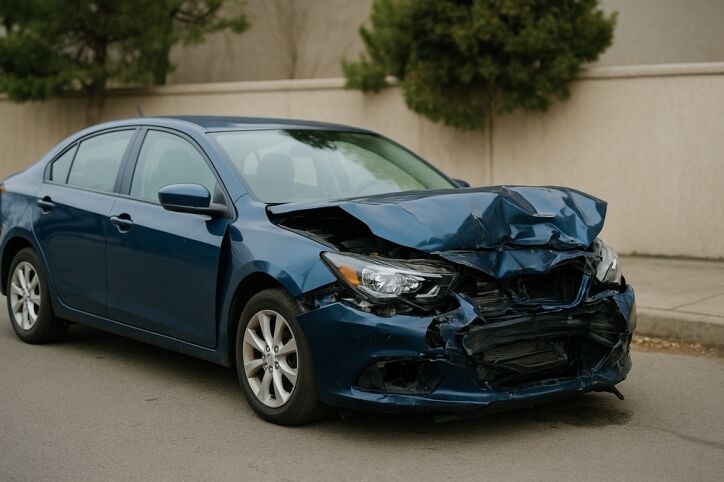
Short answer: The rear driver is often responsible for an Idaho rear-end collision, but fault is not automatic. Idaho Code § 49-638 requires a reasonable and prudent following distance in light of speed, traffic, and road conditions. Evidence of an unsafe lane entry, reversing, defective brake lamps, an unreasonable stop, or a chain reaction may support responsibility by another person. The complete sequence and causation evidence control.
What Idaho’s following-distance law requires
Idaho Code § 49-638 says a driver may not follow another vehicle more closely than is reasonable and prudent, considering the vehicles’ speed, the traffic, and the highway’s condition. It does not establish one fixed number of seconds or feet for every situation.
What is reasonable on a dry, open road may be inadequate in congestion, snow, ice, rain, darkness, limited visibility, or downhill travel. Vehicle weight, traffic changes, sight distance, tire and brake condition, and the time available to perceive and react may matter. Evidence—not a generic spacing rule—must show what happened.
When the rear driver is commonly responsible
Responsibility may rest primarily with the rear driver when reliable evidence shows that driver:
- followed too closely for the traffic or road conditions;
- looked away or used a device instead of monitoring traffic;
- approached stopped or slowing traffic too fast;
- failed to adjust to snow, ice, rain, darkness, or limited visibility;
- drove while impaired or too fatigued to respond safely;
- operated with deficient brakes or tires; or
- made a late or ineffective evasive response.
Weather does not automatically excuse a rear impact. Poor conditions may increase the following distance and caution a reasonable driver needs. Vehicle damage, video, event data when available, witness accounts, driver statements, and scene evidence may help test the sequence.
When the front driver may share responsibility
The front driver’s conduct can be relevant when evidence shows an unexpected reverse movement, nonfunctioning brake lamps or signals, an unsafe lane entry that left inadequate stopping space, an unreasonable stop in a travel lane, or an intentional maneuver that created a hazard. A lawfully stopped vehicle is not negligent merely because it was struck.
These circumstances also do not automatically transfer all responsibility to the front driver. The following driver retains a duty to stay attentive and leave a reasonable distance. The issue is whether each act or omission was negligent and a factual and legal cause of the collision.
How fault works in a chain-reaction crash
A multi-vehicle rear-end crash is not necessarily a series of identical two-car impacts. One vehicle may stop safely and then be pushed forward. Another driver may hit the vehicle ahead before a later impact. Several drivers may have been following too closely, or an unsafe lane entry may have triggered the sequence.
Investigators may compare:
- the reported order and number of impacts;
- damage locations and transfer patterns on every vehicle;
- final rest positions, debris, tire marks, roadway geometry, and conditions;
- each occupant’s description of one impact or several;
- dash-camera, business, home, bus, or traffic-system recordings;
- event, telematics, or vehicle-system data when it exists and can be reliably extracted; and
- statements made before participants had an opportunity to compare accounts.
Contact damage alone may not establish impact order or pre-impact speed. When those issues matter, a qualified reconstruction professional should identify the data, methods, assumptions, and limits.
How Idaho comparative responsibility changes the result
Idaho permits responsibility to be divided. Under Idaho Code § 6-801, a claimant’s negligence does not bar recovery only when it is not as great as the negligence or responsibility of the person from whom recovery is sought. When recovery is allowed, damages are reduced in proportion to the claimant’s share.
In a simple claim against one defendant, an equal 50–50 allocation bars recovery from that defendant. With several responsible parties, § 6-803 generally requires a separate comparison with each party, subject to its agency and acting-in-concert provisions. The Idaho comparative-fault guide explains the party-by-party analysis.
A proposed percentage from a driver or insurer is not a court finding. The current Idaho Civil Jury Instructions separate negligence, violation of law, proximate cause, burdens of proof, and comparative responsibility. Each issue must be supported by admissible evidence.
What evidence is used to decide rear-end fault?
Police records and citations
A report may identify drivers and witnesses, record statements, diagram the scene, describe conditions, and note a citation. It may be useful, but a citation or an officer’s initial assessment does not necessarily decide civil responsibility. Admissibility can depend on the item and purpose.
Photographs, video, and physical evidence
Wide and close photographs may document lane positions, sight lines, traffic controls, vehicle damage, lamps, debris, weather, and road surface. Video may show a lane change, reverse movement, stop, or impact order. Because some systems overwrite automatically, a preservation request should identify the date, time window, location, and view as soon as the source is known.
Witness and driver accounts
Record a witness’s own words, location, direction of view, attention, and any obstruction. Do not ask witnesses to coordinate descriptions. Statements made to law enforcement or insurers may later be compared with physical evidence. Uncertainty should not be filled with guesses about time, speed, distance, or the number of impacts.
Vehicle and electronic records
Repair and inspection records, brake-lamp evidence, event data, dash-camera files, telematics, phone records obtained through lawful means, and commercial-driver records may be relevant. Not every vehicle records every assumed field. System triggers, clocks, ownership, preservation, extraction method, and technical limits must be verified.
Does a rear-end ticket decide an injury claim?
No. A traffic citation and a civil negligence claim are different matters. A citation may support part of the factual analysis, but the civil claim still requires evidence connecting the conduct to the collision, the collision to the claimed injury, and the injury to the claimed losses. The absence of a citation likewise does not prove that no one was negligent.
Similarly, an insurer’s liability decision applies to its claim handling. It is not a judgment that binds every person or court. Ask what facts and policy provisions support the decision and preserve the evidence needed to test it.
What should you do when fault is disputed?
Preserve original scene and vehicle photographs, report information, witness contacts, repair and inspection records, insurance communications, and available video. Avoid altering electronic files or disposing of relevant physical evidence. Give accurate information, distinguish observation from estimate, and do not speculate.
For a chronological safety and documentation checklist, read what to do after an Idaho rear-end collision. For coverage, medical-causation, damages, and claim-resolution issues, use the companion guide to Idaho rear-end collision claims.
A case-specific fault review
The point of impact starts the inquiry; it does not end it. A reliable analysis identifies every vehicle movement, applicable rule, potential custodian, conflict, and causal link. If drivers or insurers disagree about an Idaho rear-end crash, request a consultation with Attorneys of Idaho to discuss the available evidence and current law.
Sources and legal references
- Idaho Code § 49-638, current following-distance requirements.
- Idaho Code §§ 6-801 and 6-803, current comparative-responsibility provisions.
- Idaho Supreme Court, current Idaho Civil Jury Instructions, including the negligence, violation-of-law, proximate-cause, burden, and comparative-responsibility instructions applicable when supported by the case.
This article provides general legal and safety information, not legal advice. Fault, causation, admissibility, deadlines, insurance coverage, and recovery depend on the facts and current law. Reading this page does not create an attorney-client relationship.
Legal review
Legal reviewer
Reviewed by J.W. Bond , Founding Attorney and Partner on September 2, 2026.